AI Strategy
Why 95% of AI Projects Fail - And What Uber Just Taught Us
Why 95% of AI Projects Fail - And What Leaders Keep Missing
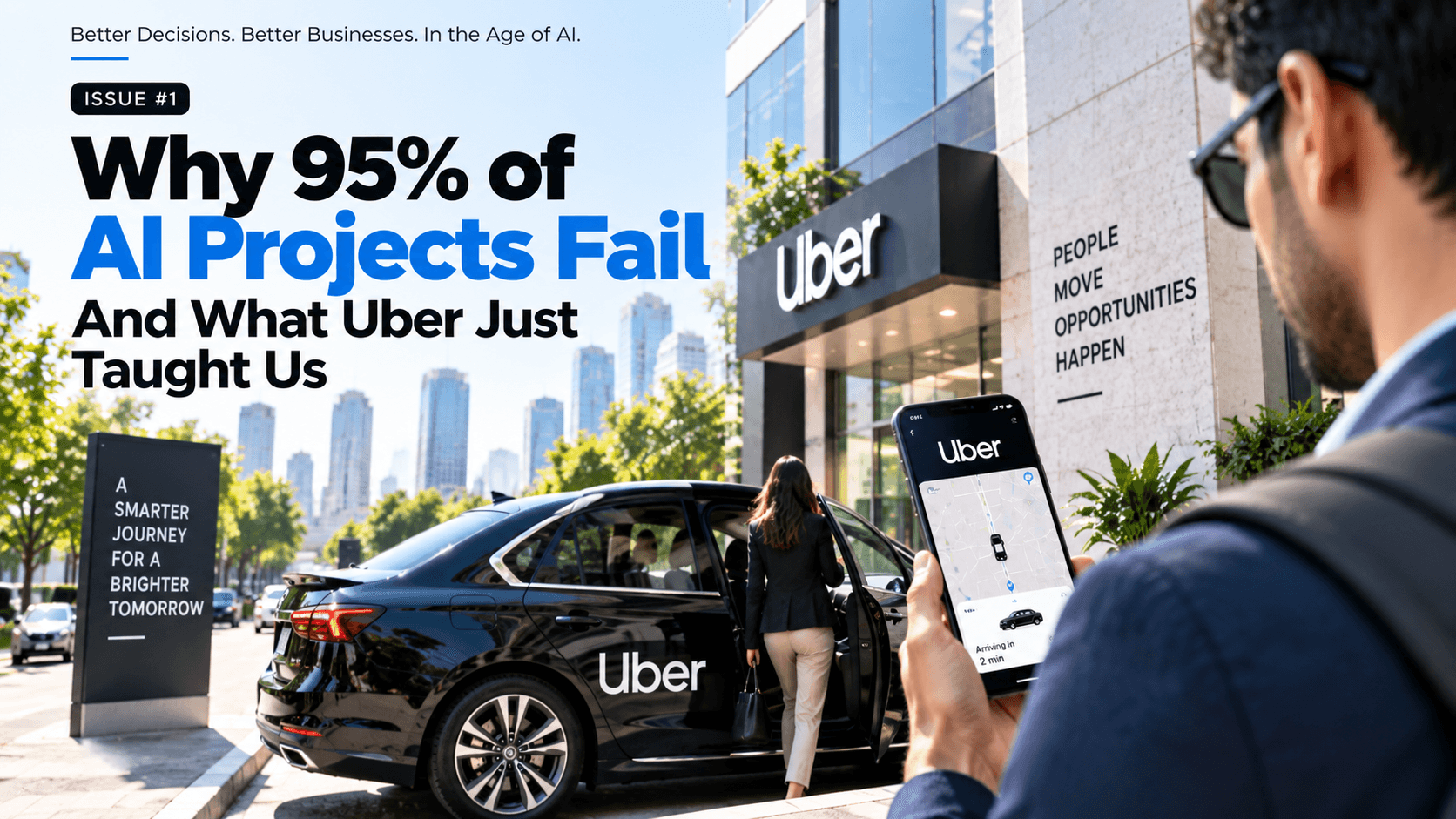
Table of contents
Everyone is talking about AI.
Almost nobody is talking about whether it's actually creating business value.
Open LinkedIn today and you'll see hundreds of posts about the latest models, AI agents, prompt engineering, and productivity hacks. The conversation is full of excitement - and for good reason. AI is advancing faster than almost any technology we've seen.
But there's a question hiding beneath all that enthusiasm.
If AI is becoming so powerful, why are so many AI projects failing to create measurable business impact?
A story that looks like a budget problem
A few weeks ago, Uber's CTO revealed something that caught the attention of almost everyone following enterprise AI.
The company had exhausted its entire 2026 AI coding budget by April.
Not because engineers were abusing the tools.
Not because the technology failed.
Quite the opposite.
Claude Code was doing exactly what it had been designed to do.
Engineers were using it to refactor large codebases, generate tests, automate repetitive engineering work and accelerate software development. Adoption spread rapidly across thousands of engineers. Uber even introduced internal leaderboards encouraging AI usage.
From an engineering perspective, it looked like a success.
Productivity increased.
Usage increased.
So did token consumption.
And so did the bill.
The more successful the rollout became, the faster the budget disappeared.
But here's the sentence that mattered most - not the budget itself.
Uber's leadership later admitted it was difficult to connect the rapidly increasing AI spend with any measurable improvement customers would actually experience.
That one admission changes how we should think about the entire story.
Because this wasn't really a budgeting problem.
It was a measurement problem.
AI worked. The business question didn't.
This is where I think many organizations unknowingly make the same mistake.
Most AI initiatives are evaluated using operational metrics.
- Number of users
- Number of prompts
- Hours saved
- Lines of code generated
- Documents created
Those numbers certainly matter.
But they don't tell you whether the business actually became better.
Businesses don't invest in AI because they want more prompts.
They invest because they expect better outcomes.
- Higher revenue.
- Lower operating costs.
- Faster decisions.
- Better customer retention.
- Reduced risk.
- Improved margins.
An AI tool can dramatically improve employee productivity while creating almost no measurable business value.
Those are two very different conversations.
And many organizations accidentally treat them as the same thing.
MIT found exactly the same pattern
Uber isn't an isolated example.
It's simply one of the most visible ones.
Earlier this year, MIT's NANDA initiative examined more than 300 AI deployments across organizations.
Their conclusion was uncomfortable.
Depending on how success was measured, between 80% and 95% of AI initiatives failed to produce measurable business impact.
The researchers didn't conclude that organizations chose the wrong models.
They didn't conclude AI wasn't ready.
Instead, they found something much more fundamental.
Most organizations never clearly defined - before implementation - what business outcome would prove the investment had succeeded.
Without that definition, there was nothing objective to measure later.
Success quietly became opinion instead of evidence.
And once that happens, every AI project starts looking successful because people are busy using it.
The decision beneath every AI decision
Here's the insight I keep coming back to.
Most executives believe they're approving an AI project.
They're not.
They're approving a business hypothesis.
Whether they realize it or not.
Every AI investment contains an assumption.
If we introduce this capability... this business metric should improve.
The problem is that very few organizations ever finish that sentence.
They stop at:
We're implementing AI.
But implementing AI isn't a business strategy.
It's simply a technology activity.
Until someone can confidently say,
We expect customer onboarding time to fall by 40%.
or
We expect support costs to reduce by 25%.
or
We expect proposal turnaround time to shrink from five days to one.
...there isn't really a business hypothesis.
There's only optimism.
Why this keeps happening
After studying numbers of AI implementations and following the experiences of organizations adopting AI at scale, I keep seeing the same three patterns.
1. Technology feels tangible. Value doesn't.
Choosing between OpenAI, Claude or Gemini or any other LLM models feels like progress.
But defining success is much harder.
So organizations naturally spend more time comparing vendors than agreeing on what should actually change.
2. Activity gets mistaken for progress.
AI creates visible movement almost immediately.
Usage increases.
Dashboards light up.
Employees become more productive.
Leadership feels momentum.
Business outcomes take months to appear.
Sometimes they never do.
Motion is easy to measure.
Value is much harder.
3. Ownership quietly disappears.
IT owns implementation.
Engineering owns adoption.
Finance owns the budget.
Business leaders own outcomes.
When responsibility gets divided this way, something surprising happens.
Everyone owns part of the project.
Nobody owns whether it actually succeeded.
The AI Value Equation
Before approving any AI initiative, I believe leadership teams should answer five questions together.
Not after deployment.
Before it.
1. What business problem are we solving?
Not "Where can we use AI?"
What problem is valuable enough to justify solving?
2. Which business metric must move?
Revenue?
Margin?
Retention?
Cycle time?
Risk?
Just Pick one.
3. Who owns that metric?
Not the AI team.
A business leader whose performance depends on that specific number.
4. How will we know this worked?
Six months from today -
what evidence would convince us this investment was worthwhile?
5. If AI usage doubles tomorrow...
does business value double too?
If the answer is no...
you're probably measuring adoption rather than impact.
My perspective
Over the next few years, building with AI will become more dramatically easier.
Generating code.
Writing reports.
Creating content.
Launching agents.
Those capabilities are rapidly becoming commodities.
Which means the real competitive advantage is shifting somewhere else.
Not into better models.
But into making better decisions.
The organizations that outperform won't necessarily have access to smarter AI.
They'll simply become better at asking one question before every investment:
What business outcome are we buying?
Because AI rarely fails because it lacks intelligence.
It fails because organizations never defined, in advance, what success was supposed to look like.
Decision of the Week
Before approving your next AI initiative, ask one question in the room.
If this project succeeds exactly as planned...
Which business metric changes first?
And just as importantly...
Who is personally accountable for proving that it changed?
If nobody has a clear answer, you probably aren't funding a business decision.
You're funding an experiment.
And those two things should never be confused.
Thanks for reading the first issue of Strategic Insights.
Every few days, I'll break down a real business event, not to report the news, but to uncover the strategic decisions hiding beneath it.
Because in the AI era, technology is becoming abundant. Sound judgment isn't.